
The year is 1950, and Felipe Arias has a short window to convince the president. As Chairman of the Joint Chiefs of Staff, he needs to make the case for action with a thinly stretched military and intelligence reports that, history will later show, aren't all accurate.

This high-pressure moment was, in reality, part of a virtual White House Decision Center simulation held earlier this semester in Assistant Professor Melinda Haas's Leaders & U.S. Foreign Policy class (PIA 2362) at the University of Pittsburgh School of Public and International Affairs (SPIA). Staff from the Harry S. Truman Presidential Library and Museum led the exercise, which dropped Arias (MPIA '26) and his classmates into the days following North Korea's invasion of South Korea. Each student played one of Truman's key advisors, including the Secretaries of State and Defense, the Joint Chiefs, the Vice President, and the Press Secretary.
Students prepared position memos in advance, worked through primary source documents, and deliberated in presidential, military, and diplomatic advisory groups before reconvening as a full Cabinet. A simulated press conference followed, with classmates and facilitators pressing their "President Truman" on escalation risks, defense spending, and public support. Following the simulation, students wrote policy memos comparing their results to Truman's actual decision.
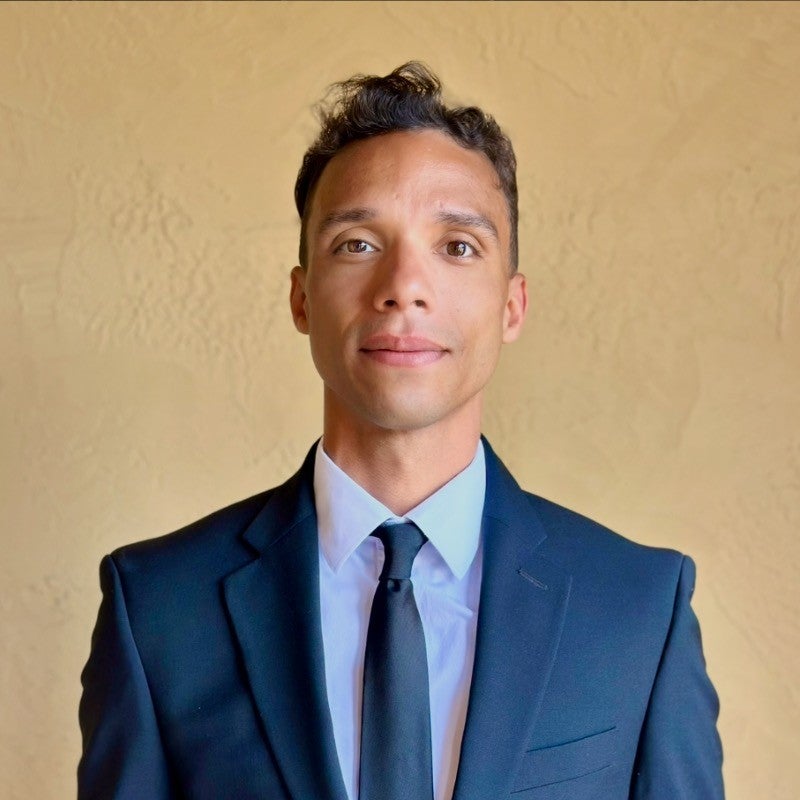
Arias brought firsthand military experience to the role of the nation's top military officer. After earning his undergraduate degree in political science from the University of Pittsburgh at Johnstown in 2016, he spent six years in the U.S. Navy as an aviation rescue swimmer. He graduates this December with a Master of Public and International Affairs (MPIA) in Security and Intelligence Studies.
To prepare as General Omar Bradley, he read the Truman Library's briefing booklet, declassified intelligence reports from the National Archives, and memos from Haas that laid out the military figures and capabilities of the United States, Soviet Union, China, South Korea, and North Korea. The numbers were stark. U.S. military personnel had dropped from 12 million to 1.5 million, and troop withdrawals had left roughly 8,000 in the region. South Korea's 100,000 poorly trained troops were expected to deter the Soviet Union, with 3 million personnel, and China, with 450,000 men near the Korean border. North Korea, meanwhile, had 120,000 experienced troops. Arias recommended that the United States increase military spending and reallocate troops to the region.
"My reasoning was that a buildup would send a credible signal that the United States was willing to take costly action to compel North Korea to pull back north of the 38th parallel," he said.
Looking back on the experience, he said the hardest part wasn't the debate itself. It was working only with what advisors knew at the time, including intelligence that later proved to be wrong.
"It would have been easy to use hindsight to correct for these mistakes; however, the assignment required us to use the information from the time of the events," he said. "You had to make a good-faith effort to put aside your own biases and historical knowledge, while simultaneously choosing a course of action that you felt genuinely addressed the Korean crisis and the goals of the administration."
In the room, the challenge was as much about persuasion as policy. Arias had to plead his case in a short amount of time while classmates competed with their own interests, goals, and agendas. It's a skill, he believes, that transcends foreign policy and will serve the participants well, no matter where their careers take them.
Being pushed that way is what Arias values most about his time at SPIA.
"One of the most important aspects of higher education is not solely to learn more about any given topic, but to have your ideas rigorously challenged by your peers and professors whose knowledge and experience far surpass your own," he said. "I have been very impressed by and grateful for the SPIA faculty that I have taken courses with. They are very knowledgeable in their fields, and their passion shows in the way they teach, challenge, and grade."
His advice to students considering SPIA for graduate school, or still early in their studies, is to expect the same.
"It is not easy, so I would not recommend coming in with the idea you're going to coast through," he said. "But if you truly have a passion for your respective field of study and you have the drive to truly learn the history, concepts, and theories, you will leave this school not only more knowledgeable, but also a better thinker."
Interested in studying security and intelligence at SPIA? Learn more about the 36-credit Master of Public and International Affairs.